Lessons menu
Road Rules Foundation
Road Signs & Markings
Speed & Stopping Distances
Vehicle Knowledge
Human Factors
Load Safety
Adverse Conditions
Hazard Perception
Warning Signs: What's Coming Up
Warning signs are a different category entirely. They do not instruct you to do any specific thing — they alert you to something ahead so you can adjust your driving before you reach it. A regulatory sign is a rule; a warning sign is information you are expected to act on using your own judgement.
The convention: a triangle with the point facing upward, a red border, and a black symbol on a white or yellow background.
The background colour is doing work. A white background marks a permanent feature of the road — a bend, a hump, a narrow bridge, a river drift. A yellow background marks something temporary: roadworks, loose stones from recent grading, an edge drop where the shoulder has been cut away, a crash ahead, a stop/go control operating through a works site.
That distinction is worth reading deliberately, because it tells you something about how long the hazard will be there and therefore how to treat it. A white-backed hump sign describes a hump that will still be there next year, and the road around it is built for it. A yellow-backed sign describes a situation that did not exist last week: the surface may be unfinished, the layout may change between one journey and the next, and there may be people working within a meter of your wheels.
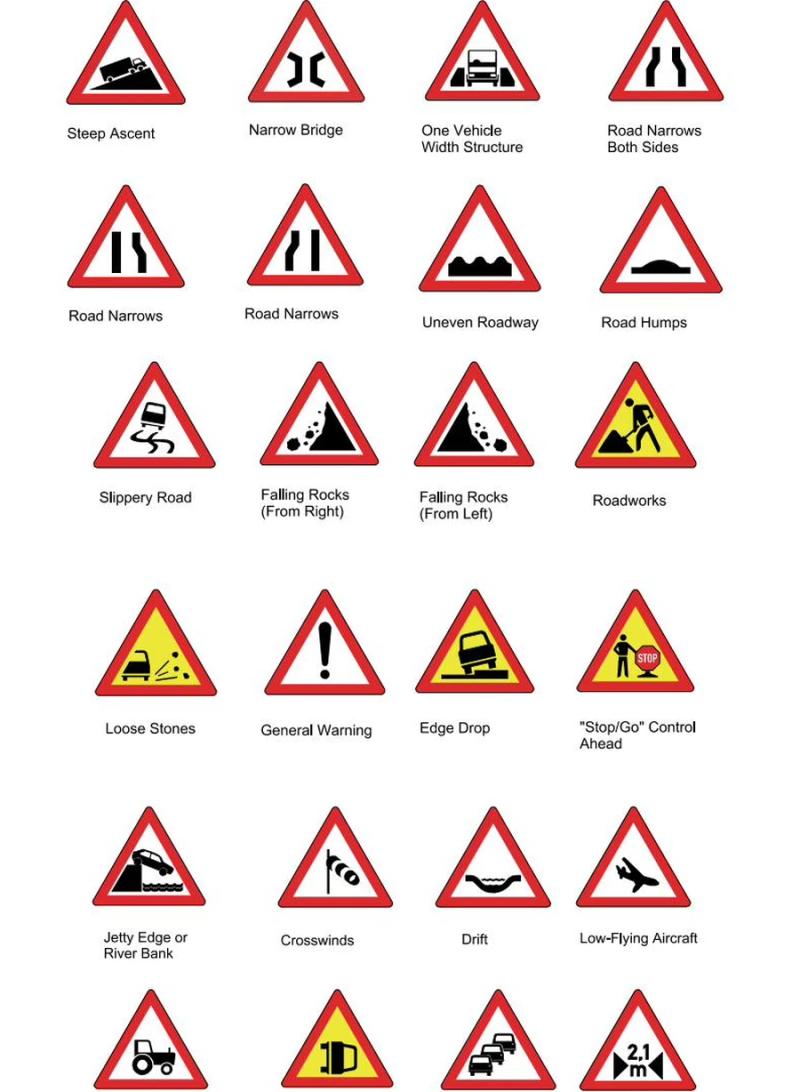
And here is the confusion worth drilling until it is automatic. Give Way is also a red triangle — but it points downward, and it is a binding instruction. Warning triangles point upward, and they are judgement calls. Same colour, same family of shape, opposite categories. Getting this backwards is one of the most common early-learner errors, and it is the difference between yielding when you must and slowing when you should.
What warning signs typically alert you to:
- Road alignment — bends, double bends, hairpins, junctions of every geometry: T, Y, staggered, skewed, side roads left and right
- Road surface or width — road narrows, uneven surface, slippery when wet
- Traffic control ahead — traffic signals ahead, roundabout ahead, and specific warnings that a Stop or Give Way is coming
- Vulnerable road users — pedestrian crossing, children, cyclists, domestic animals, wild animals
- Gradient — steep ascent or descent ahead
- Other hazards — railway level crossing, falling rocks, road works, tunnel
The mindset: a warning sign is your cue to reassess speed and positioning before you reach the hazard, not once you are in it. A "children" sign should change your speed and where your eyes are scanning immediately — not when you first actually see a child near the road. By then the sign has done nothing for you.
Key takeaways
- Upward triangle, red border = warning; downward triangle = Give Way and binding — the single most-confused pair in the sign system
- White background = permanent road feature · yellow = temporary (roadworks, loose stones, crash ahead) — and a warning sign asks for judgement applied early, when you see the sign rather than the hazard
Quick check
You see a red-bordered triangular sign with the point facing upward. What is it telling you?