Lessons menu
Road Rules Foundation
Road Signs & Markings
Speed & Stopping Distances
Vehicle Knowledge
Human Factors
Load Safety
Adverse Conditions
Hazard Perception
Regulatory Signs: Must and Must Not
Regulatory signs are legally binding instructions. Ignoring one is not a judgement call, it is a violation — the same category of rule as the Stop and Give Way signs you already know.
They split into two functional sub-types:
Mandatory signs tell you what you must do. Circular, with a solid blue background and a white symbol. They cover compulsory directions of travel (proceed left only, proceed straight only), keep-left and keep-right instructions, and routes reserved for particular users — pedestrians only, cyclists only, buses only.
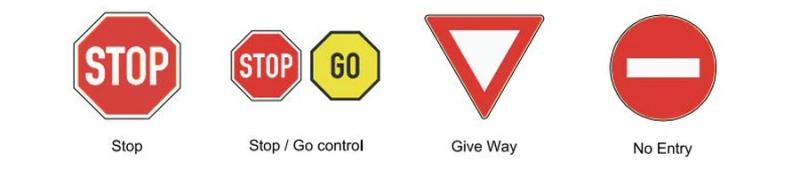
Prohibitory signs tell you what you must not do. Also circular, but with a red border or red circle on white, often with a red diagonal bar through the symbol. No entry, no overtaking, no parking, no stopping — and the numerical limits: speed, mass, axle load, width, height.
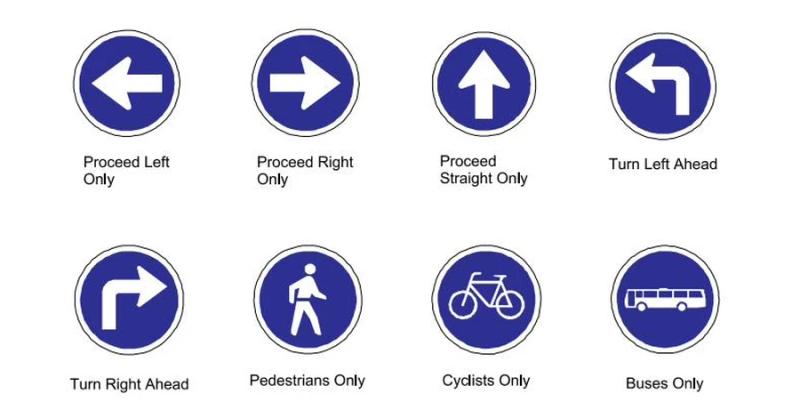
Two signs deliberately break the circular convention, because they are the two most safety-critical regulatory signs on the road:
- Stop — the eight-sided red octagon.
- Give Way — the downward-pointing red triangle with a white center.
Both are uniquely shaped so they stay identifiable by silhouette alone, even partially obscured, even approached from an angle where the word or the face cannot be read. That is a deliberate safety design, not an inconsistency.
Secondary message signs. These are smaller supplementary plates mounted below a main regulatory sign, and they change what the main sign applies to — restricting a prohibition to certain hours, to a particular class of vehicle, to a stated direction, or to a specific distance ahead.
The rule that follows: a regulatory sign is never read alone. A plate beneath it can narrow the restriction to something that does not apply to you at all, or extend it further than you assumed. Reading the circle and driving on is how people obey a rule that was not addressed to them, or break one that was.
Key takeaways
- Blue circle = must do · red circle or border = must not — both legally binding
- Stop's octagon and Give Way's downward triangle break the convention on purpose, so they read by silhouette alone; and a secondary plate beneath any regulatory sign changes who or what it applies to
Quick check
Why are Stop and Give Way given unique shapes rather than following the standard circular regulatory convention?